
My maternal grandmother Bimla Tandon has passed away at age 92. She leaves behind a younger brother and sister, three daughters, six grandchildren and three great grandchildren, whom she loved unconditionally, the way only a grandmother can. I feel many things, not all of which I can currently parse, but above all I feel gratitude that I had her in my life for so long. I was her eldest grandchild and she called me “the first flower in my garden.” She was a deeply loving, generous, wise, energetic and supportive person and the spiritual pillar of my maternal family. With her gone, a vital part of my childhood is gone too.
My father was in the army, and we changed cities every two or three years. There is a lot to be said for that kind of life, but it doesn’t really lend itself to spatial attachments. If I had a childhood home, it was with my grandmother. I spent four formative school years living in her courtyard house in old Lucknow while my father was posted in non-family stations. My memories of those times are sharp and clear, far more so than the memories of my later youth. Perhaps that is the nature of memories. Or perhaps it is because of her.
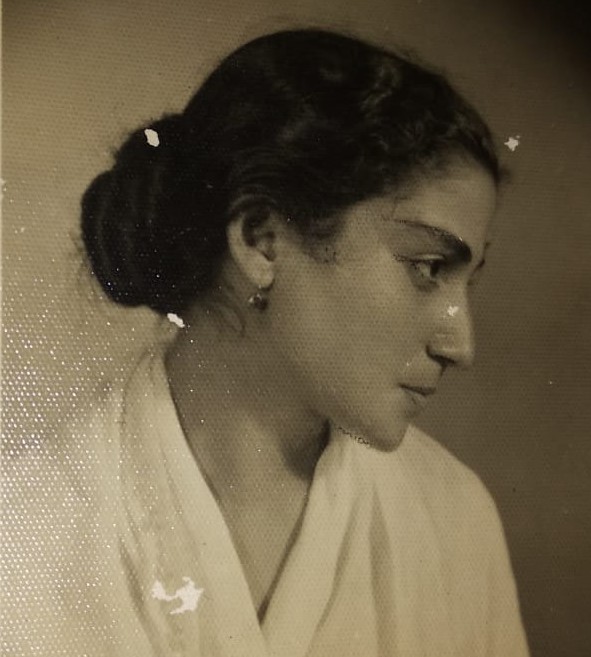
I only knew my grandmother for the second half of her life, and by the time I was old enough to hear her stories of the first half, much had changed in her situation. This I know: she faced all challenges with grace and an indomitable will to not just survive but thrive. A petite, dynamic and beautiful lady, she was born in colonial India and married Dina Nath Tandon, a nephew of the freedom fighter Purushottam Das Tandon. Money was tight, and social mores strict, especially for women and girls. Before she married, she had a discussion with my famous great uncle and told him that she wanted only one thing: to be able to continue studying. Impressed, he instructed the family to allow her to study. She went to college and university at a time when women were not even able to go to high school, bicycling several kilometers a day to her institute. Later, she taught history and eventually became the Principal of a girls’ school. She worked as an educationist for almost forty years. Many of her students kept in touch with her long after her retirement – a testament to the respect and love she commanded.
Did I mention money was tight? She and her mother – my great grandmother – used to do tailoring to supplement their income. When she married, she only had three saris that she washed and wore again and again. She told me this one day as I sat with her in front of a massive cupboard full of saris of every shade and fabric type. I was perhaps eleven then. I ran my fingers over the silks, the cottons, and the chiffons, and tried to imagine her in her distant, materially deprived youth.
After my mother and aunts were born, my grandmother made their clothes, stitching pretty frocks for them to wear. Despite opposition and financial constraints, she made sure her daughters went to the best English medium school in Lucknow. My grandfather – a dreamy, impractical man who worked as a clerk and wrote poetry to his wife – did not understand the need for this. But she did – she who told her in-laws that parents who did not educate their children do them the utmost cruelty. It is from her that we all learned the paramount importance of being educated and financially independent.
Her hands never stopped working, long after she was able to afford buying as many clothes as she needed. She knitted sweaters for all of us, made patchwork quilts out of old saris, and mended clothes and bedsheets. My father still has – and wears – a very colorful sweater she knitted for him fifty years ago. I can see her now, spectacles balanced firmly on her nose, bent over the old Singer sewing machine, one foot working the treadle. Or bent over her knitting, needles flashing with speed and accuracy, one eye on the television. If a single stitch dropped, she would unravel it all and begin again.
None of us inherited her talent, her energy, and her perfectionism. But we were like minded in so many ways. We shared a love of Indian history, mythology, plants, and philosophy. From her I heard my first stories of the mother goddess and her various forms. With her I watched melodramatic mythological TV serials. For her I watered the umpteen plants on the second floor and third floor rooftop: lemon, tulsi, sunflower, marigold, rose and so many more. Roses were her favorite. After her father passed away, she told me she could sense his presence through the smell of roses.
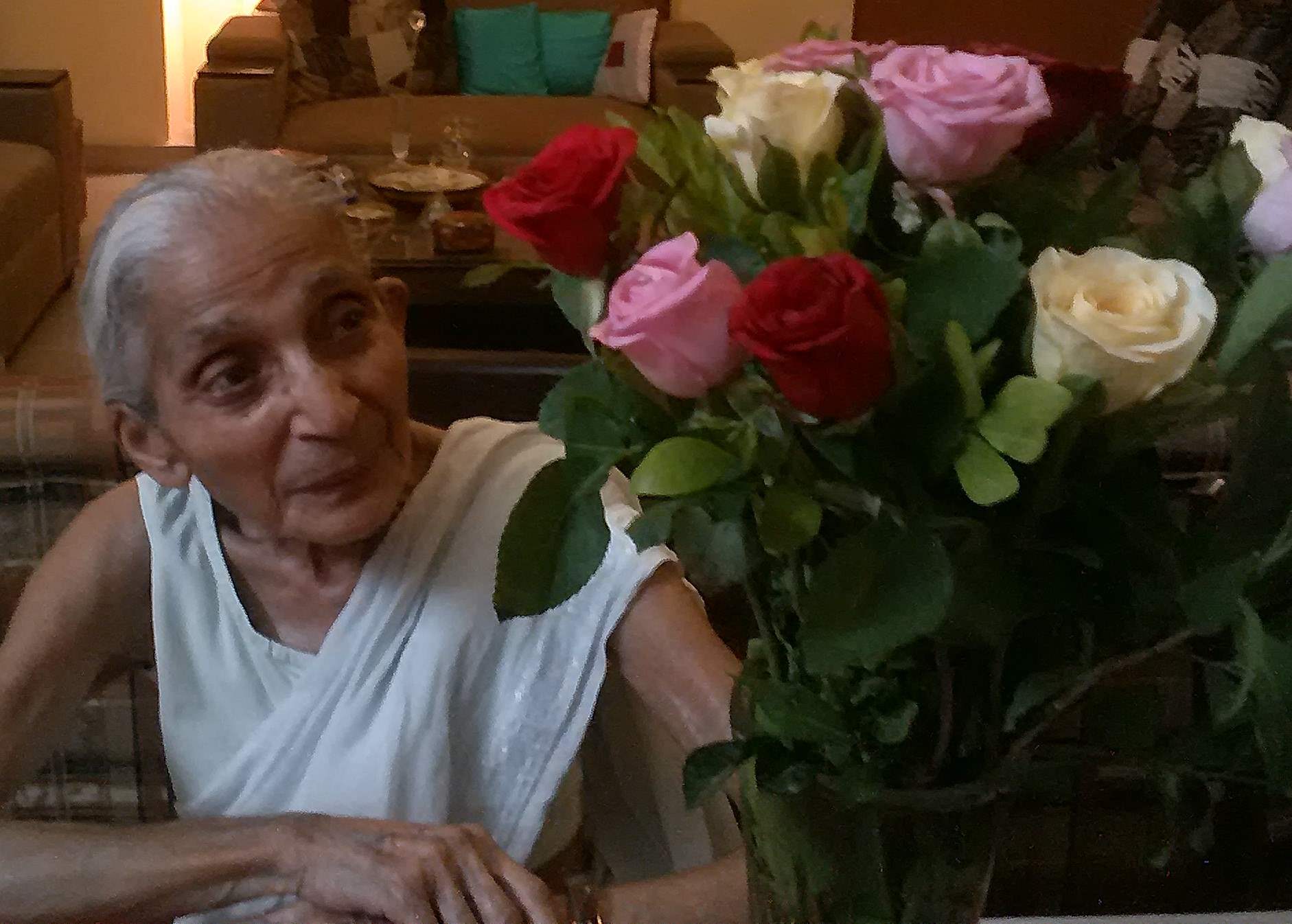
Roses were her favorite
She was the biggest cheerleader of my work, proud of my accomplishments, and forgiving of my failings. Even when I was naughty – as, for instance, when I jumped from a rooftop onto a bed – egged on by my youngest aunt – and broke the the bed, and nearly myself, she never said anything. She didn’t have to. Her unspoken disappointment was punishment enough.
Talking of broken beds – there was this one time a bed broke and my grandmother insisted she could fix it. So she did fix it and when everyone stood around dubiously, she demonstrated how fixed it was by lying down on it. See, she said with serene confidence, it is perfectly fine. And the next moment the bed did indeed break again. I still remember the laughter, including hers. (She was unhurt. It is worth noting that she was the smallest and lightest person among us, except my baby sister.)
I have so many memories like that. Have I talked about food and medicine yet? She had some knowledge of homeopathy and regularly dosed us with sweet tiny pills of mag phos, cal phos and nux vomica – a taste I will always associate with her. She also used to grind soaked almonds with a bit of milk and sugar and give us a spoon each after dinner – a tasty and nutritious treat.
Dinner was almost always the same: freshly made roti, dal, rice, and fried potatoes. And if you think that sounds plain and boring – well, it wasn’t. It was our staple food. I have never been able to replicate the taste of her cooking. Just like I can never replicate any other aspect of my childhood.
The wise old woman / grandmother is an archetype in folktales and fiction of all kinds. But the reason such a figure exists in much of my work – whether it is Shirin Mam in Markswoman or Atreyee in Night of the Raven, Dawn of the Dove – is because I was blessed with such a person in my own life. There was a particular shloka from the Gita she was fond of quoting:
tum bhoot ka paschatap na karo
bhavishya ki chinta na karo
vartaman chal raha hai
The literal translation is: don’t regret the past or worry about the future. The present is ongoing. The meaning is clear. Stay in the present moment. It is all that matters. The exact words Shirin Mam tells Kyra in Markswoman. Words I first heard from my grandmother.
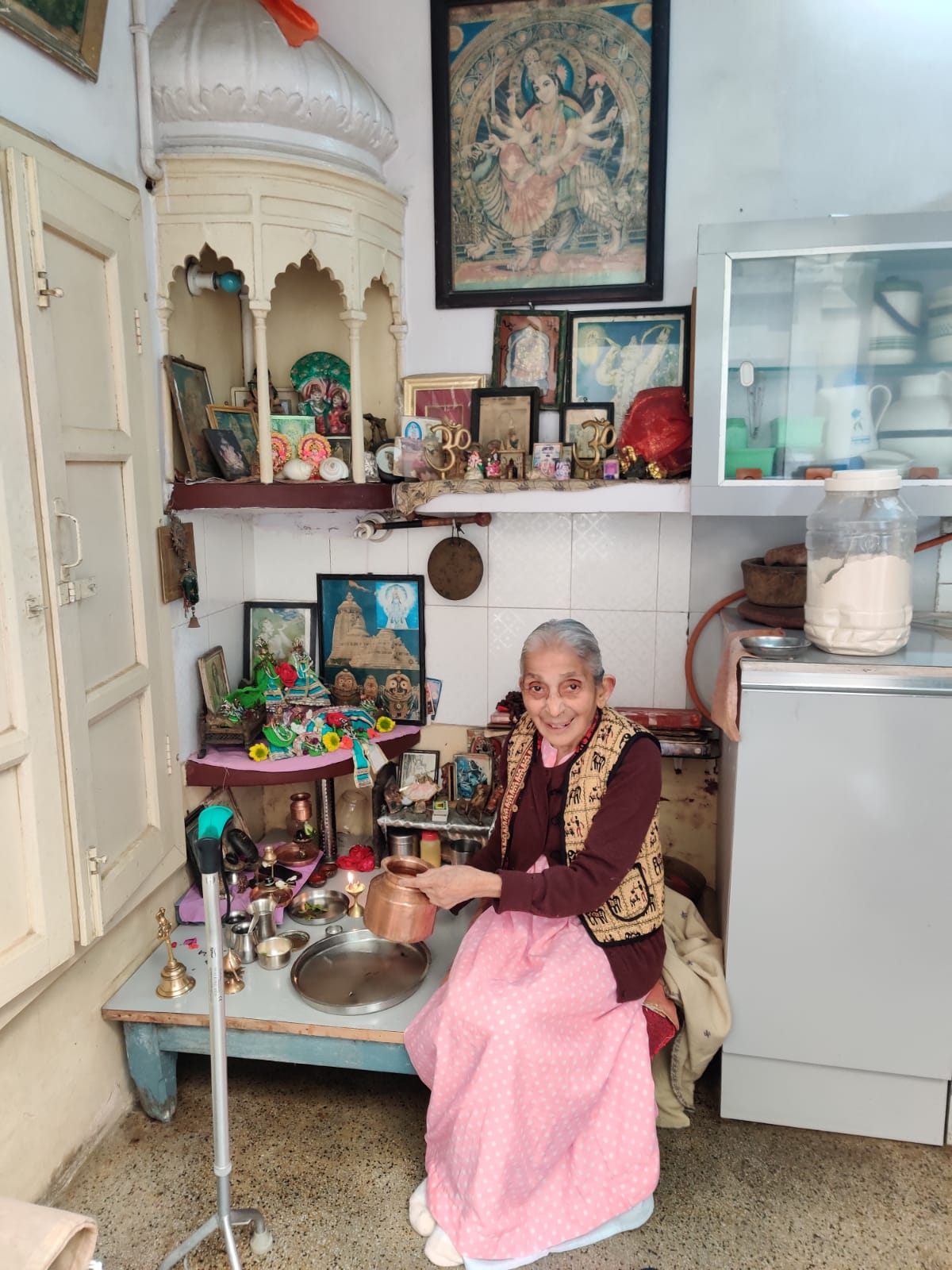
Nanu at her kitchen shrine
When I think back to those days, she is in every picture, every memory. Making rotis in the kitchen. Praying at the kitchen shrine. Striding down the street, haggling with a rickshaw wallah. Emptying the pods of shelled green peas outside the gate as a treat for the nearest cow. Sitting in a circle with the pandit for Diwali puja, listening to his stories. Buying makkhan malai or kulfi as a special after dinner treat for us all. Climbing up the stairs to the third floor rooftop to water her beloved plants. Knitting sweaters for us. Buying the third useless appliance of the month from a door-to-door salesman because she pitied him. Making gujiyas for Diwali.
She seemed inexhaustible. Even in her later years after retirement, she continued to be an early riser, beginning her day with two hours of puja, often followed by a walk through the zoological gardens. She loved to travel, and visited me in Switzerland when I was working there – a trip I know she cherished as much as I did. She learned the art of Tanjore and glass painting, gifting her beautiful creations to family and friends.
How do you summarize such a life, such a person? You cannot. She was unique and I loved and admired her not only for who she was to me, but for who she was as a person. It is my loss, and my regret, that long Covid stopped me from traveling, and I could not spend time with her in her last years.
The gardener is gone, and there is no one now who will cherish the flowers in quite the same way.


 Rati Mehrotra
My deepest condolences. Wishing you strength and comfort! Thank you for sharing this evocation of a fabulous being, one of light and love, who helped make you. Such preciousness, such creativity, and inspiration. To have known the work of the heart, mind and hand, one who nourished in so many ways, by doing, by making, by feeding, by loving, by example, yes yes, raise praise in our hearts too, for all our Beloved Gone who overcame so much, who loved us, who gifted who enable us to create and be. All praises! All gratitude.
LikeLiked by 1 person
Thank you for this beautiful tribute. There are countless happy memories and you’ve captured some great ones in this post. We’ve spent the last few days coming to terms with her passing, and dealing with grief in our own ways, but the memory of her repairing that broken bed made me laugh. The first laugh in many days. Thanks for this ❤️
LikeLiked by 1 person
You have written a beautiful tribute my dear. Your nanu was so loving and caring towards everyone especially her family. You held a special place in her heart being her first grandchild and she was immensely proud of all your achievements. She read all your books! Her face would light up when she spoke of you. Her blessings from Heaven will be there always
LikeLiked by 1 person
How lucky I have been, to be loved like that.
LikeLike
I am so sorry for your loss. You are so fortunate to have had such an incredible woman in your life. She is alive in you.
LikeLiked by 1 person