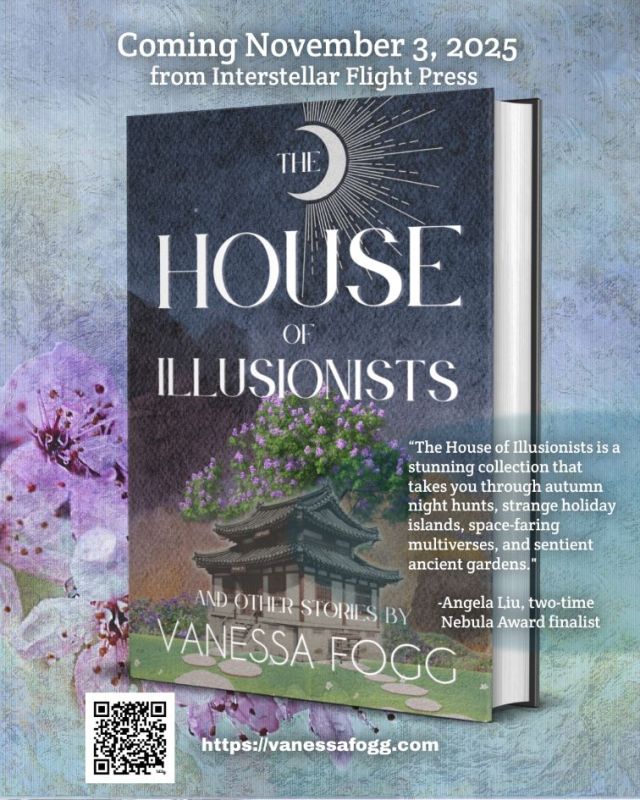
Today I am delighted to welcome writer Vanessa Fogg to my blog. Vanessa is one of my favorite short fiction SFF writers and her collection The House of Illusionists has just been released: wonderful news for her readers and for lovers of haunting, bittersweet, and darkly beautiful stories.
Welcome, Vanessa! Can you tell us a bit about yourself and your writing journey?When did you first discover your love for speculative fiction?
I have a distinct memory of sitting on the floor of my elementary school library, listening to our white-haired librarian read to us a magical story, The Lion, the Witch, and the Wardrobe. Every week during “library time,” she read us a new chapter. I was enthralled. I think I must have been in second or third grade at the time? Anyway, I fell in love with Narnia and the entire modern fantasy genre; I graduated on to Susan Cooper’s The Dark Is Rising series, Patricia McKillip, The Lord of the Rings, Ursula K. Le Guin’s Earthsea series, and more. Along the way, I also discovered science fiction. In a sense, I’ve never come out of that wardrobe to Narnia. I read non-speculative fiction as well, but the speculative is still my favorite genre to read.
As a kid, It was natural for me to try to copy what I read, and to make my own stories. My first juvenile attempts were quite derivative, but that’s how one learns. I wrote throughout my childhood and adolescence—short stories, sketches, failed attempts at epic fantasy and utterly wretched poetry. In college, I even minored in creative writing. But I majored in biology, which was another love. After college I took a long break from creative writing as I concentrated on trying to build a scientific research career. I only slowly made my way back into writing, after more than a decade away. At first I thought I should be a “literary” writer, and started off submitting a little bit here and there to literary magazines. But then I discovered the world of online speculative fiction magazines, starting with John Joseph Adam’s Lightspeed and Fantasy (note that Fantasy is now published by Sean Markey at Psychopomp). I realized then that it was speculative short stories that I wanted to write. All these years later, it’s a little head-spinning to realize that I’ve actually been published in Lightspeed and other magazines that I’ve admired for so long, and which once seemed so out of reach.
You worked as a research scientist in molecular cell biology. Has your scientific background shaped your writing in any way?
My science fiction story, Traces of Us, which appears in The House of Illusionists, is about neuroscientists and the science behind consciousness, and draws deeply on my scientific interests and experiences (like the protagonists of the story, I was a grad student at Washington University in St. Louis, and I’ve had a longstanding interest in neuroscience, even though I decided to ultimately get my doctorate in molecular cell biology). I’m interested in writing more stories that realistically involve biology and science. However, I think the biggest impact my academic training has had on my writing isn’t the influence on specific subject matter, but rather in the confidence it’s given me to be able to research and learn about any field that interests me as writing material. In science, after all, you’re constantly having to learn about new areas of research adjacent to your own; and writing scientific literature reviews is great training for reading, learning, and synthesizing a great deal of material quickly. Those skills, and the confidence to apply them, are transferrable. Another benefit is that academic training gives you a thick skin when it comes to dealing with editorial rejections. And it gives you training on how to deal diplomatically with reviewer and editorial critiques and suggestions. I’m grateful I had that training when I started collecting my first rejections in the literary world!
There is a dream-like quality to many of your stories, and a bittersweet flavour that lingers long after the reader has finished reading. What are some of the themes and influences in your work?
Some themes pop up again and again in my work, even when I don’t intend it. Mothers and daughters. Parents and children. Difficult, complex relationships. A sense of yearning. Autumn. I can’t explain it, or perhaps I don’t want to look too closely at it, other than to say we all have our obsessions.
Some influences on my work: Sofia Samatar, Ken Liu, Patricia McKillip, Kelly Link, Lev Grossman, Theodora Goss, classical Chinese poetry (in English translation), wuxia and xianxia fantasy c-dramas.
The House of Illusionists is divided into two parts: Closer Worlds and Farther Worlds. Can you tell us more about that and how you arranged the stories in this collection?
In 2012, Ursula K. Le Guin published a collection of selected short stories titled The Unreal and the Real, divided into one set of stories that take place on Earth (or a place fairly similar to our Earth), and another group of stories that take place in more otherworldly, fantastical settings. I confess I still haven’t read through this collection (although I’ve read a number of her stories), but I was inspired by her division to divide my own set of stories similarly. The House of Illusionists also has stories that take place in our own world, or in worlds that are much like our own, save for twists of time or magic. Other stories take place in secondary fantasy worlds completely separate from our own. To me, it seemed that dividing these tales into two sections, Closer Worlds (or “the real”) and Farther Worlds (the “unreal“) was thus a natural decision. Overall, there’s also difference in tone between the two sections: the Closer Worlds stories feel more “grounded” to me, while many of the Farther Worlds stories have a more mythic, fairy-tale-like feel.
Once I had that basic division of stories set, I had to arrange the stories within each broad section. I put one of my favorite stories, Wild Ones, as the first story and the title story, The House of Illusionists, as the very last. Then, within each section, I tried to arrange the sequence of stories so as to vary in tone, length, genre, and theme. I think of story collections as like playlists—there’s an overarching mood or theme, but there’s variation as well, just to keep things interesting. I hope The House of Illusionists does that for readers.
The story Sweetest, original to this collection, is sweet on the surface and dark beneath, and features some seriously scary clowns. Where did the inspiration for this story come from?
Clowns are creepy. That’s just it, man. The white paint, the make-up around the eyes, those curly wigs. It’s all just creepy. I can’t really remember what the inspiration for this one was, other than clowns are creepy and clowns running a sweets shop are even creepier. Like, do you really want to eat anything they offer?
Hah! I certainly do not. What is the most fun part of writing for you?
Getting lost in other worlds. Also, when you’ve struggling for a long time with a plot point or phrasing, and then the solution just clicks into place.
What are you currently working on?
A really personal, difficult story. That’s all I have to say about it now.
What have been some of your favourite reads of 2025?
Ooh, I love this question!
For novels this year, I’ve loved C.S.E. Cooney’s Saint Death’s Daughter, a book about a talented necromancer who starts out as literally allergic to violence (a liability in her line of work). It’s gorgeous and rich and strange, sometimes heartbreaking and cruel, sometime joyous and rollicking, mixing horror and beauty as only Cooney can. I also loved How High We Go in the Dark by Sequoia Nagamatsu, a pandemic novel (written pre-Covid) told through linked short stories. One of the story/chapters, “Pig Son,” is a about a very good, brave pig, and it made me cry and cry. Severance by Ling Ma is a pandemic novel of an entirely different kind: a zombie apocalypse/pandemic novel that’s also a bleakly sharp and funny tale about office culture, late-stage capitalism, and consumerism.
Short story collections I’ve loved: Silk and Sinew, edited by Kristy Park Kulski. A collection of Asian folk horror, told by writers of the Asian diaspora. Darkly gorgeous, moving, and unsettling. And a debut collection of horror stories, Uncertain Sons by Thomas Ha. I’m calling it now: this one is going to win major awards. Brilliant.
And although I haven’t yet read it, I’m looking forward to this year’s debut horror collection by Kristina Ten, Tell Me Yours, I’ll Tell You Mine.
Finally, in non-fiction, I really loved Stars That Pause: 2,000 Years of Asian UFO Encounters & Lore by Yi Izzy Yu and John Yu Branscum. The authors bring together fascinating accounts of UFOs/anomalous phenomena from over a millennia of written Chinese history and compare them to contemporary Asian and Western accounts. This is a “UFO book” as you’ve never seen it before. A fascinating, genre-slipping, and genre-defying work.
That sounds intriguing. My TBR just grew taller! Thank you Vanessa, for answering my questions and for all your recommendations.
***
Vanessa Fogg dreams of selkies, dragons, and gritty cyberpunk futures from her home in western Michigan. She spent years as a research scientist in molecular cell biology and now works as a freelance medical writer. Her writing has appeared in Lightspeed, Podcastle, The Deadlands, GigaNotoSaurus, Neil Clarke’s The Best Science Fiction of the Year: Vol 4, and the Bram Stoker Award-nominated anthology, Unquiet Spirits: Essays by Asian Women in Horror. Her fantasy novelette, The Lilies of Dawn, is available from Annorlunda Books. Her debut collection, The House of Illusionists, is available from Interstellar Flight Press. For a complete bibliography and more, visit her website at vanessafogg.com.


 Rati Mehrotra